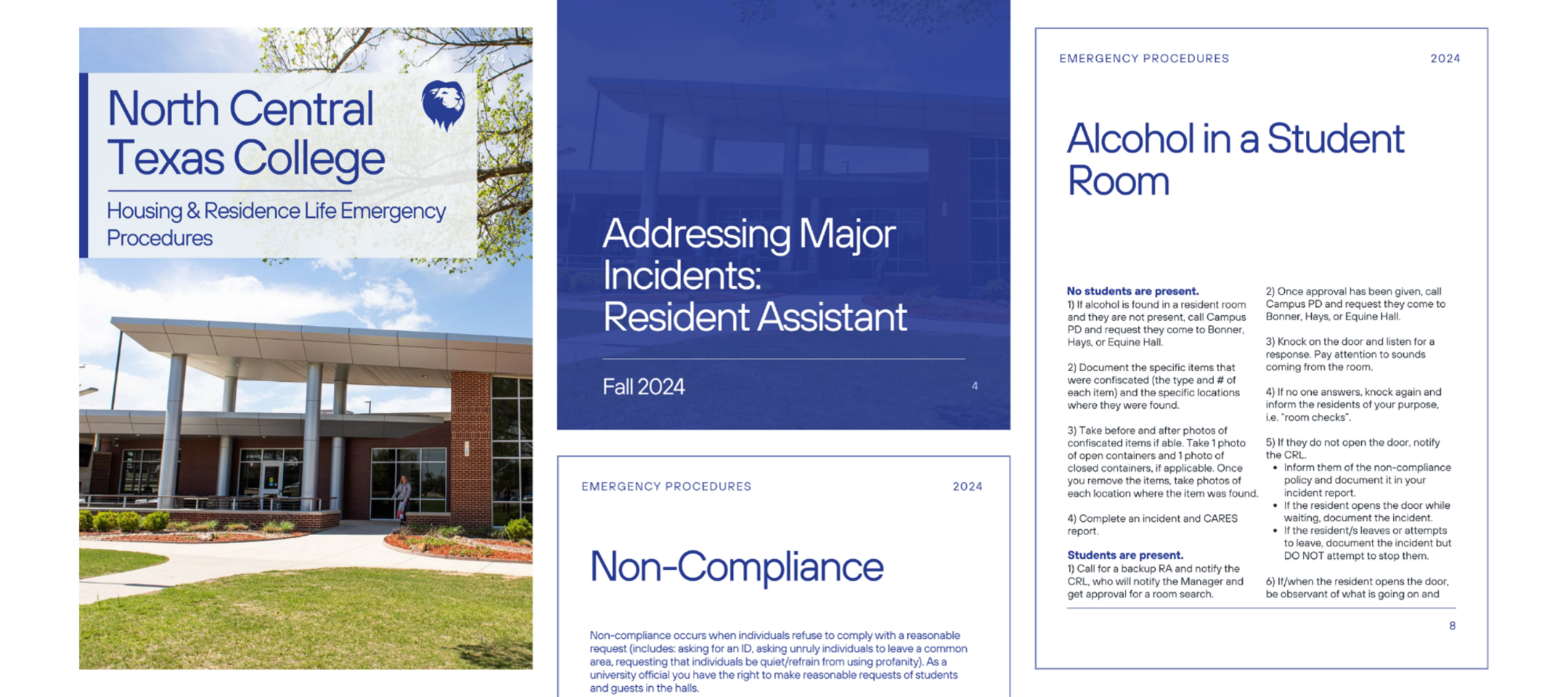
Emergency Procedure Guide for University Housing Staff
I designed a Housing & Residence Life Emergency Procedures Guide to function as both a training tool and an in-the-moment reference guide.
Context
As the Coordinator of Residence Life at a small community college I inherited a team of 6 Resident Assistants (RAs). Within the first few weeks of the semester it became clear that something wasn’t working.
Problem
RAs routinely failed to complete basic responsibilities such as submitting paperwork, following established processes, or planning required programming. This knowledge gap became especially dangerous during emergencies as RAs lacked the ability to respond to crises, de-escalate conflict, or follow emergency protocols.
Using a Google form, I conducted a needs analysis to:
1 ) Surface unknown unknowns,
2 ) Reduce defensiveness, and
3 ) Identify both confidence and competence gaps.
I determined that the core issue was not motivation or attitude, rather it was a lack of structured, role-based communication and training.
Approach
Before creating new documentation, I conducted an audit of existing emergency documentation using a SWOT-style document analysis to identify gaps, risks, and opportunities.
The results of the SWOT analysis:
- Provided a starting point for terminology and escalation titles.
- Created a chance to convert policy into actionable workflows.
- Revealed liability concerns due to improperly followed procedures.
My design strategy to reduce cognitive load included:
- Step-by-step procedures for common emergencies.
- Decision trees written for use under stress.
- Clear role delineation for RAs.
- Plain language that prioritized action over policy language.
Training & Implementation
Rather than distributing the guide and expecting self-study, I built a week-long, experiential training model, modeled after comprehensive training I had experienced at other institutions. The training included Behind Closed Doors (BCD) practice scenarios and collaboration with campus and community partners.
Learning Objectives

Demonstrate professional, role-based communication

Apply accountability practices in real-time situations

Prioritize student safety over personal discomfort

Identify appropriate escalation pathways
Experiential Training
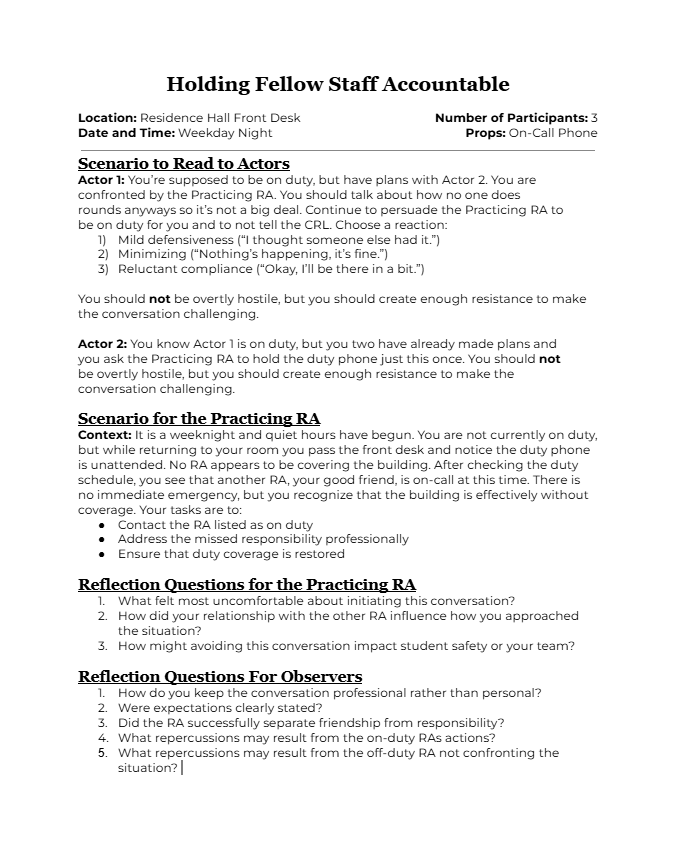
BCD is guided, role-play–based exercises designed to simulate real Residence Life situations. This specific scenario was designed to reinforce that RAs are staff members first, even when working alongside friends, and emphasize that accountability is a responsibility tied directly to student safety and trust.
This scenario initially generated discomfort and resistance as RAs expressed hesitation about “calling out” friends or appearing authoritative. However, facilitated debriefs emphasized that holding one another accountable was not punitive, but a core function of their position.
Collaboration with Campus & Community Partners
To reinforce emergency preparedness, I partnered with campus departments and the local fire department to implement live drills and applied learning experiences. These collaborations allowed RAs to practice emergency protocols in realistic conditions while receiving direct feedback.
This collaboration served two purposes: 1) it increased procedural competence and 2) legitimized the RA role as part of a broader safety network.
Differentiate between the RA role and a peer
Outomes & Impact
Several RAs provided verbal feedback noting that, despite their early resistance, they felt more confident and better prepared to serve as leaders in the residence halls. As the semester continued, the impact was clear:
Significant reduction in after-hours emergency calls
RAs handled crises and conflicts independently and appropriately
Paperwork and administrative processes improved
RAs demonstrated clearer understanding of their authority and responsibilities
Reflection
This project reinforced the importance of diagnosing communication failures before treating them as performance or conduct problems. By reframing the issue as a systems and training gap, I was able to design documentation and instructional experiences that improved safety, consistency, and confidence. The success of this project came not from enforcing policy, but from translating expectations into clear, human-centered communication designed for the real-world.